
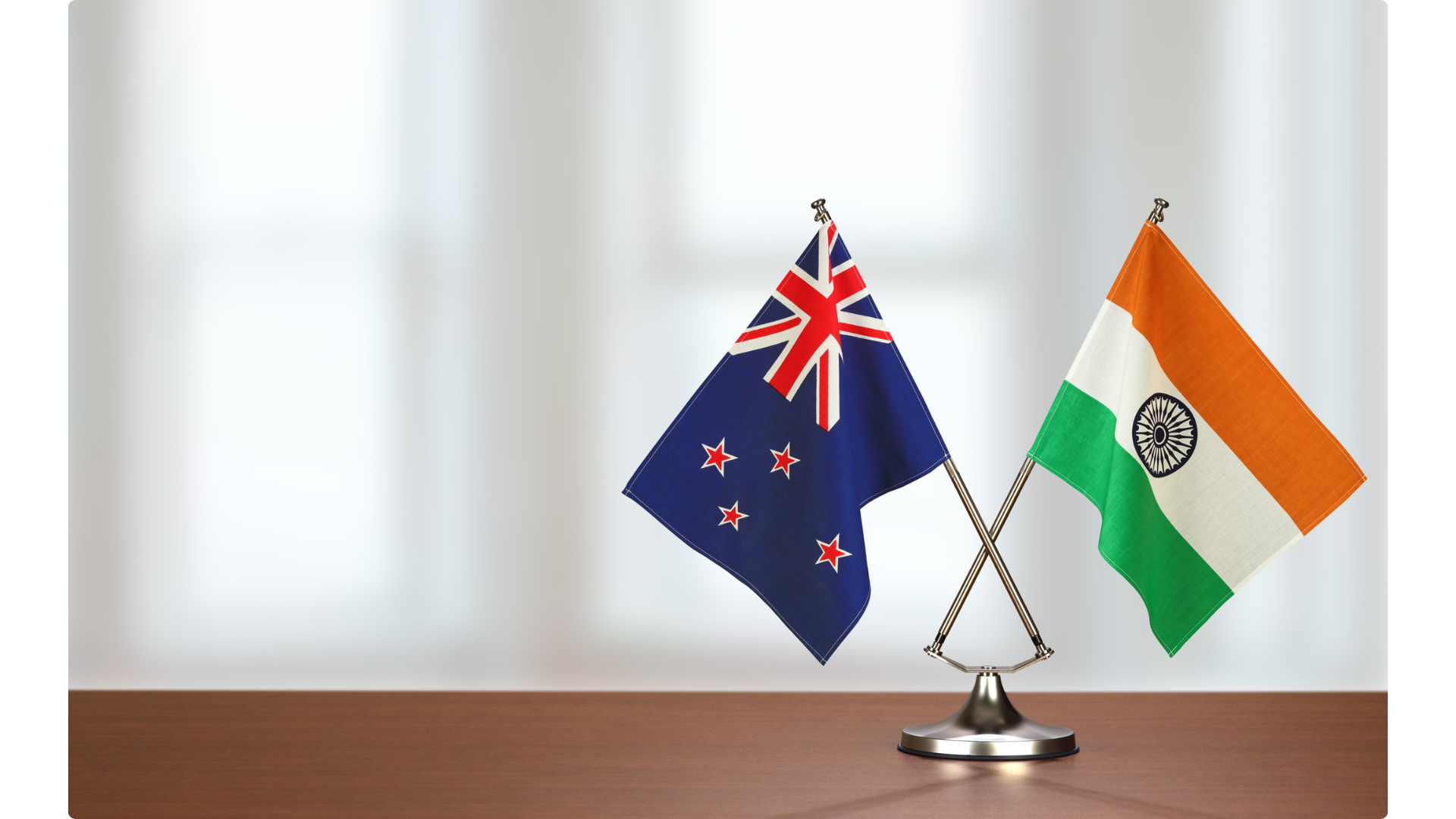
The NZ-India Free Trade Agreement was signed on 27 April 2026. It’s not yet in force – ratification by both parliaments takes a few more months – but that window is exactly the time to prepare. The businesses that move now will be the ones with a head start when the doors open.
In March 2026 , the Taupō Business Chamber hosted Hon. Todd McClay, Minister for Trade and Investment, Minister Louise Upston, and MFAT Deputy Chief Negotiator Jonas Holland for a regional briefing on the FTA. The insights in this guide draw on that conversation as well as the latest research from Tourism New Zealand and MFAT.
This isn’t just a trade story for big exporters. For Taupō businesses, the opportunity spans tourism, hospitality, agriculture, forestry, food and beverage, professional services, and more. Here’s how to start getting India-ready.
First, understand the scale of what’s coming
India has 1.4 billion people and a middle class of 500 million – larger than the entire population of the EU and UK combined. It’s the world’s fastest-growing major economy, forecast to be one of the top three economies globally by 2030.
Right now, New Zealand exports just $2 billion in goods and services to India annually, a fraction of what the relationship could be. The FTA changes the equation. For NZ exporters, around 57% of exports will enter India duty-free from day one, rising to over 80% as tariffs phase down. For the sectors most relevant to our region – forestry, agriculture, food and beverage, tourism – the gains are significant.
Key reading:
For exporters of goods and services
Step 1: Know your tariff position
The first practical step for any exporter is to find out what tariffs currently apply to your product in India, and what the FTA delivers. MFAT’s Tariff Finder tool lets you look this up by product category.
For forestry businesses specifically: India’s fumigation requirements for logs have been a significant barrier. Minister McClay confirmed at our briefing that India is close to approving an alternative fumigation method that would remove this obstacle – worth monitoring closely via MPI’s biosecurity updates.
Step 2: Check your eligibility for preferential treatment
Preferential (duty-free) treatment under the FTA requires goods to be wholly obtained or substantially manufactured in New Zealand. If your supply chain involves imported components, check eligibility with a trade advisor before marketing FTA-preferential pricing to Indian buyers.
Step 3: Get export-ready
If you’re new to exporting, NZTE offers a fully subsidised Export Essentials course (valued at $2,400) covering market selection, sales channels, pricing, compliance, and planning. It’s free, practical, and worth doing before you take your first steps into India.
- NZTE Export Essentials – my.nzte.govt.nz
- NZTE India Market Guide – my.nzte.govt.nz
- NZTE Export Support – nzte.govt.nz
Step 4: Build relationships before the tariffs drop
India is a relationship-driven market. Minister McClay said it well at our briefing: “If you put effort into this relationship, into this market… these are the rules. We give you certainty and we will respect it.” The businesses that start building Indian connections now, through trade shows, in-market visits, or distributor relationships, will be ahead of those who wait for ratification.
NZTE has an in-market team in India. Contact them here.
For tourism operators and accommodation providers
This is where the Taupō opportunity is particularly compelling. India is already New Zealand’s third largest pool of Active Considerers – 14.7 million people who are seriously considering visiting, have the budget, and have New Zealand in their top five destination choices. Last year, 81,000 Indian visitors arrived, spending an average of $5,400 per holiday trip.
The FTA will deepen people-to-people ties, grow the Indian community in New Zealand through the skilled worker pathway (up to 1,670 workers per year from our skills shortage list), and increase visiting-friends-and-relatives (VFR) travel, already the single largest purpose of visit at 48%.
What Indian visitors want, and what Taupō already delivers in spades, is natural attractions, geothermal experiences, lakes and waterfalls, walking and hiking, and wildlife. The alignment is strong. The gap is in awareness, packaging, and a few practical considerations.
Getting India-ready for tourism and hospitality
- Get visible on the right platforms
Indian travellers book through aggregators, primarily MakeMyTrip and Booking.com. If your accommodation or experience isn’t well-presented on these platforms with good photos, clear descriptions, and competitive positioning, you’re invisible to a significant portion of Indian bookers.
- Think about food
Vegetarian food options are important for a large proportion of Indian visitors. This isn’t a niche consideration, it’s mainstream. Reviewing your menu or catering options to ensure there are clear, satisfying vegetarian choices (and ideally some familiar flavours) can make a meaningful difference to the experience you provide. And this isn’t just about the evening meal – think breakfast in particular too.
- Know what they want to know
The TNZ research is clear on the top knowledge gaps for Indian Active Considerers: the best time of year to visit for specific activities, food and beverage quality and variety, how welcoming the locals are, and how easy it is to get around. Your website, social content, and booking communications can actively address all of these.
- Consider the family travel dynamic
Over half of Indian Active Considerers are travelling as families with children. Think about how your experience or accommodation presents to families, not just couples.
- Make the most of the VFR opportunity
As Taupō’s Indian community grows, through the FTA’s people-to-people provisions, the VFR market will grow with it. Connecting with local Indian community networks and ensuring your business is genuinely welcoming is part of the preparation.
Key reading:
- Tourism New Zealand India Market Snapshot (July 2025)
- TNZ India Active Considerer Monitor (December 2025)
For the agriculture and primary sectors
The FTA delivers some of the most significant wins in this space:
Sheep meat: NZ held 85% of the Indian lamb market before Australia’s FTA . That share fell to 9%. The NZ-India FTA restores parity with Australia, with the 33% tariff removed at entry into force.
Forestry: Tariffs on 96% of current trade removed immediately; 99.8% removed once fully phased in. Once the fumigation issue is resolved (which looks close), this is a significant opportunity.
Horticulture: Tariff preference on 98% of current trade including apples and kiwifruit; full tariff elimination on cherries, avocados, persimmons and blueberries over 10 years.
Mānuka honey: The 66% tariff slashed by 75% over five years, and uniquely, NZ is the only country to have secured any honey tariff reduction with India.
Wine: Immediate cut from 150% to 25–50% within 10 years, future-proofed so NZ will always have at least equivalent access to any other country.
Dairy: Full tariff elimination for bulk infant formula, dairy-based food preparations, and peptones within 7 years; new albumin quota at reduced tariff.
Wool and coal: Tariffs eliminated on day one.
For professional and business services
The FTA includes services commitments and MFN protections. For service exporters, including professional services, education, technology, and engineering, the practical question is whether it improves your ability to work with Indian clients through a local partner, project-based presence, or cross-border delivery. Legal and tax advice from a specialist is recommended before entering the market.
The FTA also opens a new Working Holiday Visa scheme for Indian nationals – 1,000 places annually and a 5,000-place annual skilled worker pathway. For businesses dealing with skills shortages, this is worth paying attention to.
Your next steps – a checklist
Right now:
- Check your tariff position at tariff-finder.govt.nz
- Sign up for MFAT India FTA updates at India-FTA@mfat.govt.nz
- Register on myNZTE and access the India market guide
- Enrol in NZTE Export Essentials if you’re new to exporting (it’s free)
In the coming months:
- Review your digital presence on Indian booking and discovery platforms
- Think about food, family, and language accessibility in your customer experience
- Start building relationships – attend India-focused trade events, connect with NZTE’s in-market team, and look at what trade shows or missions are coming up
- Talk to a trade lawyer or advisor about rules of origin and compliance requirements
Stay informed:
- MFAT India FTA Hub
- MFAT Exporter Helpdesk: exports@mfat.govt.nz | 0800 824 605
- Tourism New Zealand India Market Insights
- Taupō Business Chamber – we’ll be sharing updates as ratification progresses
The Taupō Business Chamber is here to help our members navigate what’s ahead. If you have questions about the FTA and what it means for your business, get in touch – we’re happy to connect you with the right people and resources.